Peripheral Artery Disease (PAD) Treatment in San Antonio
Peripheral artery disease (PAD) is a serious circulatory condition where arteries in the legs become narrowed or blocked, reducing blood flow. Without treatment, PAD causes leg pain, wounds that won't heal, and in severe cases, amputation. Medical Vein Clinic treats PAD in San Antonio at two locations: Stone Oak and Northwest San Antonio. Our PAD patients are treated by Dr. Thomas Gianis, a board-certified vascular surgeon with fellowship training in vascular and endovascular surgery. We diagnose PAD using ankle-brachial index testing, arterial ultrasound, and X-ray imaging. Treatment options include lifestyle changes, medications, and minimally invasive outpatient procedures including angioplasty and stenting. PAD affects 8 to 10 million Americans and is more common in people over 60, smokers, and those with diabetes, high blood pressure, or high cholesterol. Early diagnosis is critical.


Who is at Risk for Peripheral Artery Disease?
In the U.S., PAD affects 8 to 10 million adults and occurs more commonly in people of Hispanic or Black heritage and over the age of 60. You are much more at risk for PAD if you smoke, have diabetes, high blood pressure, chronic kidney disease, and/or high cholesterol. It is hereditary so if a family member suffers from PAD, you have a higher chance of developing it, too.
Common Symptoms of PAD
If you have one or more of these symptoms, you should be evaluated by our vascular specialists at Medical Vein Clinic.
If you have any of these symptoms, it could be a sign of peripheral artery disease:
When walking: leg weakness, heaviness, or painful cramping in one or both hips, thighs, or calf muscles
Leg pain that disturbs your sleep
Pale or discolored or darkened toes or feet
Leg sores or wounds that won’t heal
One leg or foot that regularly feels colder than the other
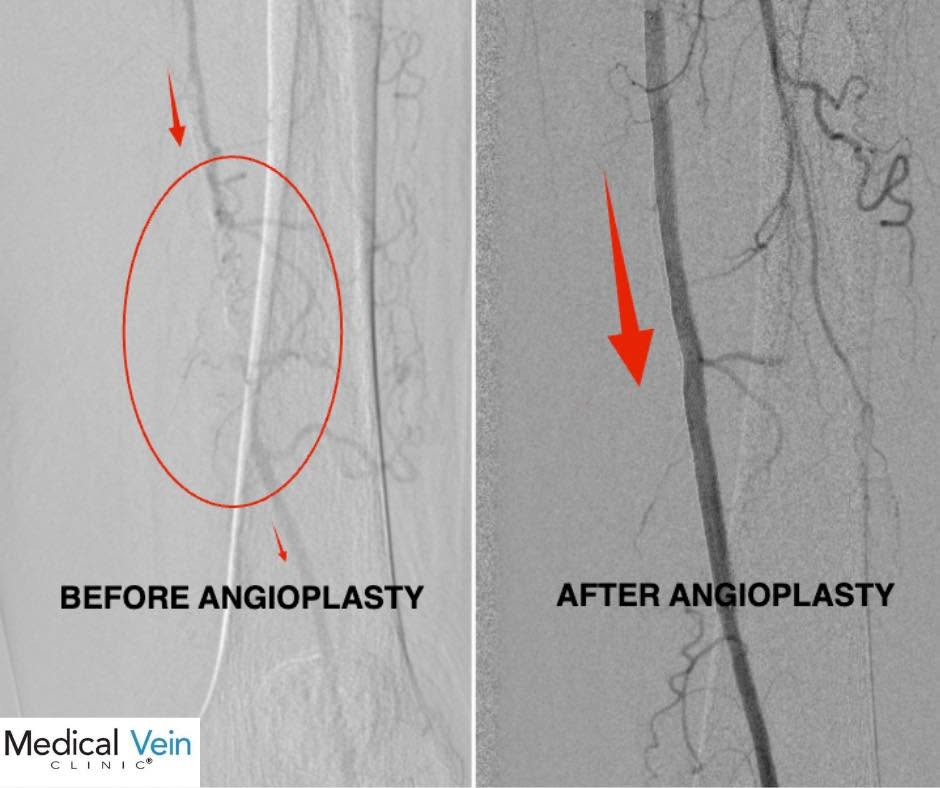
What does a blocked leg artery look like, and how does angioplasty fix it?
This angiogram is a real case treated at Medical Vein Clinic®. The image on the left shows a severely occluded superficial femoral artery (SFA), the main artery supplying blood to the lower thigh and leg. The blockage was cutting off the oxygenated blood flow the leg needs, putting the limb at risk.
The image on the right shows the same artery after angioplasty, a minimally invasive procedure that opens narrowed or blocked arteries from the inside using a catheter, without open surgery. The artery is now open and carrying blood flow normally, visible as the continuous dark line running the length of the leg.
Untreated arterial blockages like this can progress to chronic leg pain, non-healing wounds, and limb loss. Catching and treating PAD early preserves the limb and restores normal circulation.
Quick facts for patients:
- Artery involved: superficial femoral artery (SFA)
- Condition: arterial occlusion (blocked artery), a form of peripheral artery disease (PAD)
- Procedure: angioplasty
- Result: full restoration of blood flow to the affected leg
- Performed by: Dr. Thomas Gianis, II, MD, FACS, FSVS, DABVLM, RPVI, RVT, CWSP, Medical Vein Clinic
How We Diagnose and Treat PAD
Early detection and treatment of PAD is important. Our arterial disease specialists will evaluate your arterial leg health by conducting a series of tests. These can include comparing the blood pressure in your ankle with that in your arm, an ultrasound mapping of the blood flow in the legs, and X-ray imaging to see if there is any blockage in your arteries.
Our medical team advocates for a multi-prong approach including important lifestyle changes. If you are a smoker, consider quitting. Exercise regularly and adopt a heart-healthy diet to reduce arterial narrowing.
Medications are also used to treat PAD. Cholesterol contributes to narrowing and reduces blood flow. So, part of your treatment regimen may include cholesterol-lowering drugs, like statins, aspirin, and other blood thinners. Blood pressure medications to lower blood pressure and limit stress on the arteries may also be prescribed.
In more advanced cases of PAD, surgical intervention may be required. In our state-of-the-art medical suites, our board-certified vascular surgeon performs:
Meet Your PAD Specialist: Dr. Thomas Gianis, Board-Certified Vascular Surgeon
Our PAD patients are cared for by a team led by Thomas Gianis, II, MD, FACS, FSVS, DABVLM, RPVI, RVT, CWSP a Board-Certified Vascular Surgeon. Dr. Gianis is recognized for his compassionate patient care and vascular disease treatment excellence. He earned his medical degree at Ross University School of Medicine, interned in general surgery at Vanderbilt University, completed his general surgical residency at Memorial University Medical Center in Savannah, Georgia, and a fellowship in vascular and endovascular surgery at the University of Virginia Medical School.


What to Expect After PAD Treatment
Since 2017, Medical Vein Clinic has treated thousands of patients in their state-of-the- art San Antonio clinics. Our primary focus is treating leg circulation issues, getting patients to move around without pain and enjoy life again. When patients feel better and increase their daily activities, other medical conditions, like high blood pressure and diabetes often resolve.
At Medical Vein Clinic, Healthy Legs Take You Further™
Book Your Appointment Today
210-622-8000
Covered by Medical Insurance. Se Habla Español.
Medical Vein Clinic has two San Antonio locations:
Stone Oak at 18831 Meisner Drive, San Antonio, TX 78258 and Alamo Ranch Northwest San Antonio at 5742 W. Loop 1604 N., San Antonio, TX 78251.
San Antonio lymphedema and lipedema care
Treatment at two convenient locations
We treat lymphedema and lipedema at our Stone Oak and Northwest San Antonio/Alamo Ranch offices.
Stone Oak
18831 Meisner Drive
San Antonio, TX 78258
Alamo Ranch
5742 W. Loop 1604 N.
San Antonio, TX 78251
Love your legs again™
Covered by Medical Insurance
Se Habla Español
Our Offices
Stone Oak
18831 Meisner Drive
San Antonio, Texas 78258
Alamo Ranch
5742 W. Loop 1604 N.
San Antonio, TX 78251
Call Us
Email Us
Office Hours
Monday - Thursday
8 am to 5 pm
Friday 8 am to 12 pm
Friday
8 am to 12 pm