By: John S. Hogg MD, DABR, DABVLM, RPVI, RPhS, RVT, RVS
What Does “Advanced” Vein Care Mean?
Advanced vascular care means finding every leaking (backward-flowing) vein before treating any of them, and at our San Antonio clinic that starts with a detailed vein ultrasound. Treatments like radiofrequency ablation (RFA), Varithena foam and sclerotherapy work best when they’re aimed at the right veins.
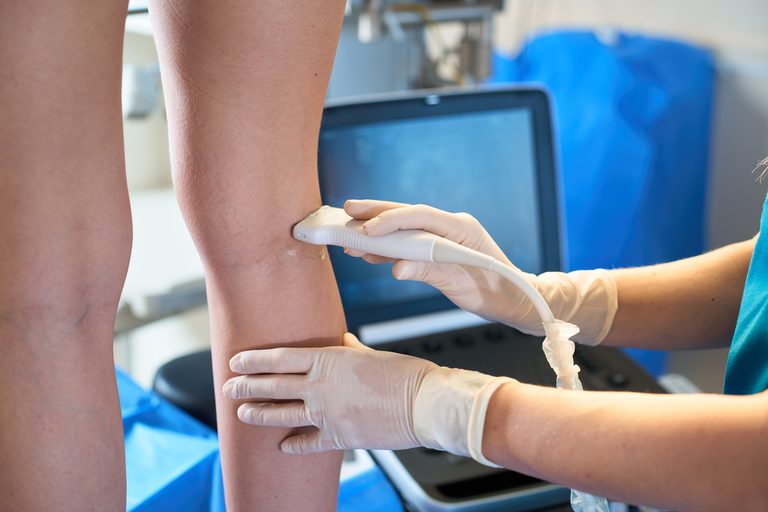
That’s why the ultrasound done before treatment matters so much. At Medical Vein Clinic® in San Antonio, every treatment plan starts with a full vein ultrasound map of both legs. We scan the one-direction valves, time how long blood flows the wrong way, and trace each ‘leak’ back to where it starts.
Dr. John Hogg, the clinic’s founder and a board-certified vascular specialist with more than 30 years of experience, built the practice around this step.
Why Do Varicose Veins Come Back After Treatment?
Vein disease is often inherited, and tends to get worse over time. So new ‘leaks’ can form years after a successful treatment, particularly from sitting or standing at work or at home. Sometimes a small leak that’s hard to see on a first scan grows into a main problem later.
Think of it like an older roof. You can fix one leak, and a few years later water finds another way in. A detailed map of every vein gives your treatment the best chance of lasting, and a follow-up scan shows us early if anything new appears.
What a Full Vein Ultrasound Checks
A quick vein ultrasound looks just for blood clots. A vein reflux mapping study is much more comprehensive and looks for leaky valves, as well as any evidence of blood clots or scarring from prior clots. They’re different tests, and only the second one tells us why your veins are bulging or your legs are swelling. (Reflux just means blood flowing backward, down the leg, instead of up toward the heart.)
- We scan you with your head slightly tilted up on the table. Lying completely flat can hide a leak, because gravity is what makes a weak valve fail.
- We gently squeeze your calf, or ask you to bear down, and time how long blood flows the wrong direction. In the veins near the skin, backward flow lasting more than half a second means the valve is leaking. In the deep veins in the middle of your leg, the cutoff is one second.
- We follow every vein that could be the source: the long vein running up the inside of your leg, the shorter one on the back of your calf, a side branch on the front of your thigh, and the small connector veins that link surface veins to deep ones.
- We check the deep veins for damage from an old blood clot or a blockage. What we find there changes which treatments are safe for you.
- We measure how wide each vein is and how deep it sits under the skin, as well as its tortuosity. That decides whether heat, foam or another method will work best.
When we’re done, you have a written map of your leg: which veins leak, for how long, how big they are and where they are located. Your treatment plan is built from that map. Learn more about how leaky valves cause problems on our vein disease page.
Why a Quality Scan Matters
A vein ultrasound takes time and experience. Every leg is different, and a careful study follows the veins from the groin to the ankle. Just as important, the person performing the scan needs to know what to look for and how to interpret what they find.
At Medical Vein Clinic®, our team has specialized training in vascular imaging, ultrasound technology, and venous and lymphatic medicine. Dr. John Hogg is board-certified in Diagnostic Radiology and Venous and Lymphatic Medicine, with additional credentials in vascular interpretation, vascular technology, and phlebology sonography.
Dr. Thomas Gianis, our board-certified vascular surgeon, also holds board certification in Venous and Lymphatic Medicine and registered credentials in vascular interpretation and vascular technology. Joshua Trock, PT, DPT, RVT, brings specialized training in vascular ultrasound, lymphedema therapy, and wound care.
These credentials matter because an ultrasound is only useful if we understand what it shows. We need to identify which valves are leaking, trace the backward flow to its source, and determine whether other veins are contributing to the problem. We also need to examine the deep veins, particularly if you have a history of blood clots or previous vein treatment.
Small side branches and connector veins can make a difference, too. If one misses the source of the problem, the wrong vein may be treated, or leave an important part of the disease unaddressed.
The goal is to understand what is happening in your legs before deciding how to treat it. That is why we start with a detailed ultrasound study and build the treatment plan around what we find.
When a Careful Ultrasound Changes the Treatment Plan
The cases that look simple often aren’t. These are the ones where a full map matters most:
- Leg sores (ulcers) that won’t heal quickly. Leg sores (ulcers) that won’t heal quickly. A leaky connector vein sitting right under the wound is often what keeps it open, because it deprives the area of oxygen.
- Swelling that could come from the veins, the lymph system, or both. The fix is different for each. See our lymphedema page.
- Legs that have had a blood clot before may have scarring narrowing these important deep veins. Treating the surface veins can help or can make things worse, depending on how the deep veins healed.
- Veins that have come back over the years after earlier treatment. There may be a problem higher up with compression of veins in the pelvis or abdomen.
- Varicose veins on the inner thigh, the back of the thigh or the groin and vaginal area. These can trace back to problem veins in the pelvis.
If you’ve had vein treatment before, bring any records or ultrasound reports you have. They help us see what was done before.
How We Choose Your Treatment
The newest device isn’t always the best choice. Sometimes an older, proven treatment fits your vein better.
Radiofrequency ablation has been used for more than 20 years, and studies show it closes the treated vein in more than 95% of cases in the months after treatment.
For many legs, it’s still the right choice. We pick the treatment after we’ve seen the map, and we’ll tell you why we picked it. You can read about each option on our treatments page.
Frequently Asked Questions About Advanced Vein Care in San Antonio
Do I need an ultrasound before vein treatment? Yes. Treating varicose veins starts with knowing exactly which veins are leaking, and how bad. The detailed mapping ultrasound shows us that. Insurance also requires a documented ultrasound before it will cover treatment.
Does the ultrasound hurt? No. We put warm gel on your leg and glide a small handheld probe over the skin. You’ll feel some pressure when we squeeze your calf, and that’s about it.
How long does the vein ultrasound take? About 45 -60 minutes for both legs. You’ll be partially tilted with your head-up for part of it, so wear shorts or loose clothing.
Will my insurance cover it? Most insurance plans, including Medicare, cover the ultrasound and treatment when your symptoms are documented.
Schedule Your Vein Ultrasound in San Antonio
If your legs ache, swell or feel heavy by the end of the day, or your veins have come back after earlier treatment, a vein ultrasound is the place to start. Call Medical Vein Clinic at 210-622-8000 or book your vein evaluation online at medicalveinclinic.com/book-an-appointment.
We have two San Antonio locations: Stone Oak at 18831 Meisner Drive and Northwest San Antonio at 5742 W. Loop 1604 N.
Dr. John Hogg, MD, DABR, DABVLM, RPVI, RPhS, RVT, RVS, is a board-certified radiologist specializing in Vascular & Interventional Radiology and the CEO/Founder of Medical Vein Clinic®. With over 30 years of experience, Dr. Hogg has established San Antonio’s leading vascular treatment clinic, helping thousands of patients since 2017. To learn more, visit https://www.medicalveinclinic.com.